
Wasabi Protocol exploited for more than $5 million

The Wasabi Protocol defi derivatives platform has been exploited for more than $5 million across multiple blockchains. The attack has been attributed by blockchain security firms to a compromised admin key, which allowed the attacker to upgrade contracts to steal assets.

Polish Zondacrypto exchange stops processing withdrawals amid possible insolvency

The Polish cryptocurrency exchange Zondacrypto faced complaints that withdrawals were not being processed as far back as December 2025, but the crisis seems to have escalated. CEO Przemysław Kral attempted to assuage insolvency fears by pointing to a cryptocurrency wallet containing around 4,500 BTC (~$330 million) as proof of assets, but he also admitted that the keys to the wallet were known only to the exchange's previous CEO and not transferred during the company's 2021 sale. The former CEO has been missing for four years.

Polish authorities have launched investigations into the apparent collapse. Losses have been estimated at 350 million zł (~$96 million).

Poland's Prime Minister Donald Tusk has also recently accused Zondacrypto of sponsoring conservative and right-wing politicians, including Polish President Karol Nawrocki. Nawrocki has repeatedly vetoed legislation aiming to regulate the crypto sector, describing it as overly burdensome to crypto businesses. Tusk has also alleged that Zondacrypto was funded by the Russian mafia and Russian intelligence services. These allegations are also being investigated by Polish authorities, and one report citing the country's Internal Security Agency claims that the Kremlin-linked Tambovskaya Bratva Russian mafia group took over the exchange as far back as 2018.

Volo Protocol exploited for $3.5 million, most recovered

The Sui-based Volo Protocol defi yield platform was exploited for around $3.5 million after an attacker targeted three vaults holding wBTC, XAUm (a tokenized gold asset), and the USDC stablecoin.

Volo says they have frozen or recovered all but around $60,000. They have also said they are "prepared to absorb this loss", rather than passing losses along to their users.

Aave faces approximately $200 million in bad debt after Kelp DAO bridge exploit

The Aave defi lending protocol is grappling with anywhere from $177 million to $236 million in bad debt after the Kelp DAO bridge exploiter used Aave to cash out their stolen rsETH. Rather than selling the tokens, the attacker used the rsETH as collateral to borrow wETH, leaving Aave stuck with the huge quantity of unbacked rsETH. Although Kelp and Aave both froze affected markets, the attacker had already cashed out. The attacker borrowed essentially all of the wETH available on the platform, leaving those who'd loaned those tokens unable to withdraw.

Aave maintains a $50 million insurance fund to absorb bad debt. However, this can't cover such a huge shortfall.

RaveDAO accused of pump-and-dump as token crashes 98%

Binance and BitGet have confirmed they are investigating allegations that RaveDAO orchestrate a pump-and-dump to push its RAVE token price from around $0.25 to more than $27 over the past few weeks, before the token price plummeted back down to $0.66. Concerns were first raised by blockchain investigator zachbxt, who called on the exchanges to investigate. He later wrote, "While it's good the exchanges responded, I find it unlikely this activity wasn't spotted internally before I raised it publicly."

RaveDAO describes itself as a "community-driven global rave powerhouse", and sells NFT tickets to rave events.

RaveDAO has denied any responsibility for the recent price movements, but did not address allegations of enormous token concentration with the project's team or large transfers to exchanges around the time of the price jump.

Kelp DAO bridge hacked for $292 million

An attacker stole 116,500 rsETH (restaked ether) from a blockchain bridge run by Kelp DAO. Based on prices at the time of the theft, the stolen tokens would be worth around $292 million — however, the attacker is likely to face challenges selling a quantity of tokens that amounts to 18% of rsETH's circulating supply.

When tokens are bridged from one chain to another, the tokens on the original chain are locked in the bridge smart contract while the token is used on the other chain, preventing its owner from double-spending the asset. With 116,500 locked rsETH now stolen, those using the token on other blockchains are now holding possibly unbacked tokens.

The rush for holders to offload their dubiously backed tokens is likely to worsen contagion throughout defi protocols, where those platforms could be left holding the bag. Some platforms, including Aave, Lido Finance, and Ethena, have paused markets involving rsETH to try to protect themselves.

This hack has set the new record for the largest defi hack in 2026, following the $285 million Drift exploit on April 1.

Rhea Finance exploited for $18.4 million, some recovered

Rhea Finance's lending product was exploited for around $18.4 million after an attacker took advantage of a bug in the platform's slippage protection feature. The stolen assets affected both platform and user funds.

Some of the stolen tokens were returned by the attacker to the protocol, and around $4.35 million USDT were frozen by its issuer, Tether. Altogether, around $10 million was recovered, leaving $8.4 million outstanding.

Russian Grinex exchange halts trading after $13 million+ exploit

The Russian cryptocurrency exchange Grinex has halted trading after disclosing a hack of more than 1 billion rubles (more than $13 million). The exchange has claimed on Telegram that the hack was perpetrated by "foreign special services" they allege were trying to harm Russian financial independence.

According to blockchain intelligence firms TRM Labs and Chainalysis, Grinex is a rebranded version of the Garantex cryptocurrency exchange that was shut down and sanctioned in March 2025. Two of its operators were subsequently criminally charged in the US.

CoW Swap users lose estimated $1.2 million after DNS hijacking

Users who visited the website for the CoW Swap DEX aggregator on April 14 were unknowingly redirected to a malicious website that drained their crypto wallets. An attacker was able to socially engineer CoW Swap's domain registrar, allowing them to redirect visitors to a malicious site for a period of several hours. CoW Swap has estimated that people who used the service during that time lost around $1.2 million.

Users lose $9.5 million to fake Ledger wallet app on the Apple App Store

After a fake version of the Ledger cryptocurrency wallet app made it onto the normally highly curated Apple App store, customers lost $9.5 million dollars to the malicious product. Believing it was a genuine Ledger product, people entered their seed phrases into the app, then discovered their wallets were immediately drained.

One victim, a musician who goes by G. Love, wrote: "I lost my retirement fund in a hack/Scam when I switched my Ledger over to my new computer and by accident downloaded a malicious ledger app from the Apple store. All my BTC gone in an instant." According to him, he lost 5.9 BTC (~$445,000).

Crypto sleuth zachxbt traced some of the stolen funds through Kucoin, a Chinese cryptocurrency exchange that was recently fined and forced to exit US markets over licensing and anti-money laundering failures. "The three largest victims lost seven figures each," he wrote.

Apple removed the malicious app from their App Store on April 13, six days after it had been added.

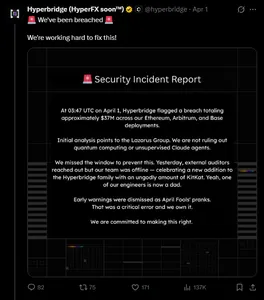
Hyperbridge exploited two weeks after April Fools' hack joke

Screenshot of a tweet by Hyperbridge: We've been breached
We're working hard to fix this!
Security Incident Report
At 03:47 UTC on April 1, Hyperbridge flagged a breach totaling approximately $37M across our Ethereum, Arbitrum, and Base deployments.
Initial analysis points to the Lazarus Group. We are not ruling out quantum computing or unsupervised Claude agents.
We missed the window to prevent this. Yesterday, external auditors reached out but our team was offline - celebrating a new addition to the Hyperbridge family with an ungodly amount of KitKat. Yeah, one of our engineers is now a dad.
Early warnings were dismissed as April Fools' pranks. That was a critical error and we own it.
We are committed to making this right.Hyperbridge April Fools' tweet (attribution)
On April Fools' Day, the Hyperbridge blockchain bridge project posted a tweet claiming that the North Korean Lazarus hacking group had drained $37 million from the project. A linked blog post contained a Rickroll GIF and an explanation of "Why Hyperbridge can't be hacked".

The following day, a Hyperbridge developer posted a screenshot of a blockchain transaction, writing "Lmao the uniBTC exploiter is testing Hyperbridge. I hope you have a quantum computer bro". Another commenter replied, "Rule #1 dont actively provoke attackers".

About two weeks later, an attacker was able to forge a transaction to change the admin rights for the Polkadot/Ethereum bridge contract, allowing them to mint 1 billion DOT tokens. They were able to cash out about $2,500,000 due to limited liquidity.

The April Fools' posts have since been deleted.

Bitcoin Depot hacked for $3.67 million

A yellow and black Bitcoin ATM with "Bitcoin sold here" printed on the sideA Bitcoin Depot kiosk (attribution)
Bitcoin ATM operator Bitcoin Depot has disclosed a March 23 hack in which attackers stole 50.903 BTC (~$3.67 million) from company wallets. According to the company's disclosure with the SEC, the exploiters gained access to the company's IT systems and wallet credentials, allowing them to steal the assets.

Bitcoin Depot is the largest operator of crypto ATMs globally and in the United States, with approximately 8,700 kiosks in the US and 9,200 worldwide.